Research headlines rarely tell the whole story. Start with the study type, who participated, what was measured, and what questions remain.
Research foundations
Getting Started with NF Research
Learn how evidence develops, then open trusted sources for NF information, published studies, and clinical trials.
How to understand research evidence
Use these labels as a quick guide to how mature the evidence is—not as a guarantee that a finding applies to an individual person.
EstablishedSupported by stronger human evidence or clinical guidance
EmergingPromising human evidence that still needs confirmation
Early-stageLaboratory, animal, computational, or very early human work
Where should I start?
New to NF research? Begin with the NIH overview, use PubMed to find published literature, and use ClinicalTrials.gov to find registered clinical trials.
Search major U.S. research databases, funding programs, data portals, trial resources, and NF clinical-research programs. A small number of major international sources are included for research that may not appear in U.S. databases.
How to use this directory: Start with original study records, publications, datasets, or government documents whenever possible. A source’s inclusion does not mean every item it contains is clinically proven, current, or appropriate for an individual person.
Published research
Latest NF publications
Recently indexed NF and schwannomatosis research articles from PubMed. These are publications, not funding awards or clinical-trial registrations.
Showing 0 of 0 qualifying publications
Loading publications…
Why can a future publication date appear? PubMed may supply an upcoming journal-issue date for an article already available online. Future-dated publications are hidden by default; clear the checkbox above to show them. The Hub retrieves up to 40 recent candidates so filtering does not hide relevant results, displays 12 by default, and lets you continue showing more until every qualifying retrieved publication is visible. The automatic search groups neurofibromatosis OR schwannomatosis and can return matching publications from any institution, including the NF clinics listed above. Use the PubMed link above for the complete result set. Automatically retrieved from PubMed.
Funded research
Recently funded NF projects
Active NIH-funded projects whose titles explicitly identify NF, neurofibromatosis, or schwannomatosis. A funding award does not mean a study is complete or has published results.
0 of 0 retrieved projects meet the NF-title rule
Loading funded projects…
The automatic NIH RePORTER search treats neurofibromatosis OR schwannomatosis as alternatives, then keeps projects whose titles explicitly identify an NF-related term. Matching awards from listed clinics can appear without a separate clinic feed. Automatically retrieved from NIH RePORTER. Inclusion does not mean a project is complete, clinically proven, or applicable to an individual person.
Research participation
Find an NF Study or Clinical Trial
Explore drug and non-drug NF research—including interventional trials, observational research, natural-history studies, and registries—then open the official ClinicalTrials.gov record to confirm eligibility, locations, contacts, and current status.
The ClinicalTrials.gov request groups neurofibromatosis OR schwannomatosis and does not limit results to drug trials. Study categories and research topics are derived from wording in each registered record and may not capture every relevant detail. Matching studies from any sponsor or clinic can appear automatically; eligibility, recruiting locations, and contacts must still be confirmed on the official study record.
Explore where research happens
NF Research Map
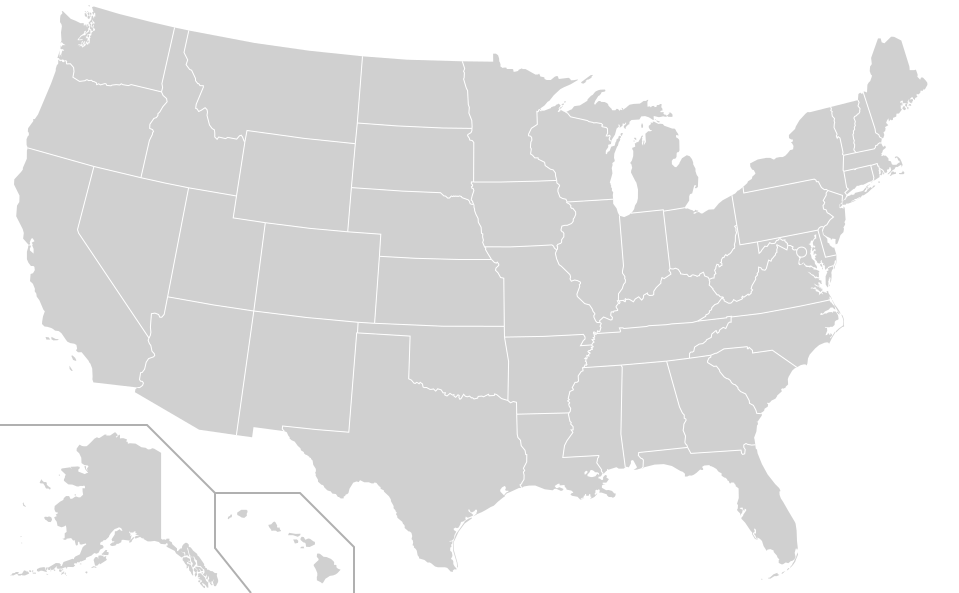
Switch between a consolidated United States view and a separate world view of maintained international research sources. Events are not included.
Map boundaries: The U.S. view consolidates maintained NF research-program links and locations returned by the current ClinicalTrials.gov feed. The world view currently maps maintained international literature and trial-search sources—not every NF institution or study worldwide. Always confirm status and location on the original source.
Explore and connect current research
Research Radar
Choose a Radar bubble to focus both the underlying research records and Follow the Research. The optional search narrows both sections further; clearing the filters returns both sections to all current activity.
Explore current activity
Research Radar
See which topics appear across the Hub’s currently retrieved PubMed publications, NIH-funded projects, and ClinicalTrials.gov studies. Select a bubble, narrow the records if useful, or carry the topic into the research-question builder.
Building the current research picture…
How to read this: Counts show research activity in the limited records currently retrieved by the Hub—not evidence quality, treatment effectiveness, total worldwide research, or how close a topic is to a new treatment. Records may appear in more than one topic. Keyword rules assign topics without an AI API; uncertain items remain under Other emerging research.
Documented research connections
Follow the Research
Your selected Research Radar bubble and optional search control the threads shown here. Each thread follows official identifier connections from a registered study or NIH-funded project to any documented publication and shows only stages that genuinely belong to that record.
0 current threads
No documented connection found for the current Radar selection.Try clearing the Radar search or choosing another topic. The Hub will not attach unrelated records to complete a timeline.
Connection rule: Threads use identifiers supplied by PubMed, NIH RePORTER, or ClinicalTrials.gov. They are chronological research records—not evidence ratings—and the Hub never implies that unrelated items belong together merely to fill a missing stage.
Explore connected research
NF Discovery Lab
Choose an NF topic to explore related publications, funded projects, registered studies, and trusted research sources together. This view organizes existing Hub records; it does not determine whether a finding is established or applies to an individual person.
NF research explorer
Explore a connected research topic
Choose a topic and, if useful, add a narrower phrase. The Lab brings related Hub records into one organized view without treating every record as the same kind of evidence.
Choose a body system or a whole-person concern to explore possible NF connections, questions researchers study, and reviewed starting points. NF affects every person differently; an item appearing here does not mean that every person with NF will experience it.
Interactive diagram
Choose an area of the body
Select a marker to open its educational overview and research-question shortcut.
🧠
Selected starting point
Brain & nervous system
Explore tumors of the brain, spine, and nerves, neurologic changes, headaches, seizures, and related monitoring or research questions.
Reviewed starting points: The body-system and whole-person summaries use current GeneReviews chapters for NF1, NF2-related schwannomatosis, and LZTR1- and SMARCB1-related schwannomatosis. They are navigation aids, not complete lists of manifestations, surveillance recommendations, or treatment guidance.
Learn, play & verify
Test Your NF Knowledge
Take a 20-question knowledge challenge built from reviewed NF and medical sources. Every test includes 15 NF questions, one pop-culture question, one sports question, one algebra question, and two all-ages random questions.
20 questions
NF Knowledge Challenge
Choose a level, answer every question, and submit when you are ready. The selected level prioritizes questions at or near that difficulty, so some neighboring levels may appear. This is educational—not a measure of medical expertise.
0 of 20 answered
NF questions are based primarily on GeneReviews and other NIH/NLM resources, with CTF, FDA, ClinicalTrials.gov, and other authoritative sources used where appropriate. Question content was last reviewed August 2026.
Ask NF Research
Build a stronger research question.
Choose what you want to study. This tool will create a detailed prompt you can copy into ChatGPT or another research assistant. It does not search or answer the question on this website.
1Fill it inAdd only the details you want to share.
2Copy the promptReview it and copy it with one click.
3Open an AI toolPaste the prompt, then check the response carefully.
4Show it as textIf the AI tool displays it as a document, click “Show in text field.”
Your generated prompt
Ready to copy
Copy prompt is unavailable until you enter what you would like to research.
Enter a research question above to create your prompt.
Use your prompt with an AI assistant
Copy the finished prompt, then open the assistant you prefer.
Paste one or more study, trial, article, or research-page links. Select everything you want reviewed, then copy the generated prompt into ChatGPT or another research assistant. This website does not open or analyze the links itself.
1Fill it inAdd only the details you want to share.
2Copy the promptReview it and copy it with one click.
3Open an AI toolPaste the prompt, then check the response carefully.
4Show it as textIf the AI tool displays it as a document, click “Show in text field.”
Your link-review prompt
Ready to copy
Copy prompt is unavailable until you enter at least one complete link beginning with http:// or https://.
Paste one or more research links above to create your review prompt.
Use your prompt with an AI assistant
Copy the finished prompt, then open the assistant you prefer.